
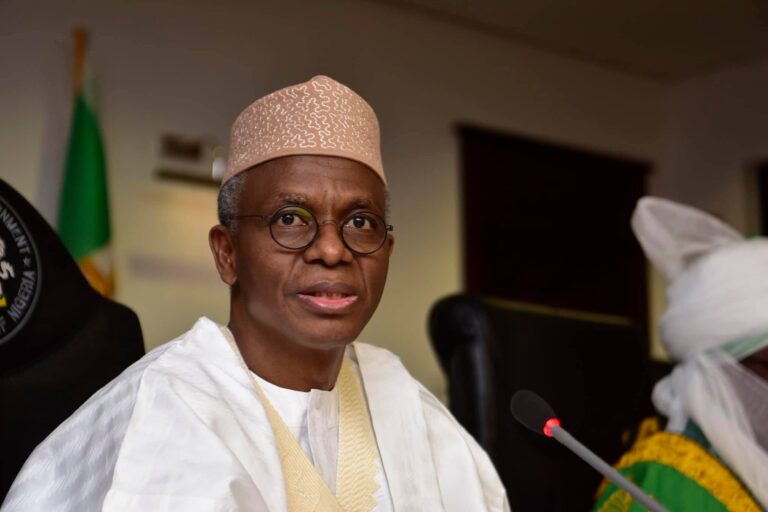
* Nasir El-Rufai
The Pathfinder
Wednesday February 25, 2026
Please, share this story:
Justice Joyce Abdulmalik of the Federal High Court in Abuja has refused to grant bail to the former Governor of Kaduna State, Nasir El-Rufai, ruling that the request was premature given that he has not yet been formally arraigned.
The legal proceedings were stalled on Wednesday because the defendant was absent from court, remaining in the custody of the Independent Corrupt Practices and Other Related Offences Commission (ICPC) for a separate investigation.
The Department of State Services (DSS) is seeking to prosecute the former governor on a three-count charge involving the alleged wiretapping of the National Security Adviser, Nuhu Ribadu.
According to the DSS, El-Rufai breached the Cybercrimes Prohibition Act of 2024 and the Nigerian Communications Act of 2003.
The charges follow a televised interview in which the former governor reportedly admitted to intercepting the NSA’s phone communications, claiming he overheard directives for his own arrest.
During the court session, a heated debate broke out between the legal teams over the defendant’s continued detention.
El-Rufai’s lawyer, Oluwole Iyamu, SAN, argued that the court should exercise its discretion to grant bail immediately, suggesting that the shuffle between various security agencies was an oppressive tactic to keep his client behind bars.
However, the DSS counsel, Oluwole Aladedoye, SAN, countered that the court could not grant bail to a defendant who had not yet taken a plea or been produced in court.
In her ruling, Justice Abdulmalik sided with the prosecution, stating that she could not entertain a bail application until the defendant is formally arraigned.
She noted that while a charge had been filed as early as February 3, the court must follow due process before considering a release. Consequently, the judge adjourned the case until April 23, 2026, for the formal arraignment of the former governor.
The criminal charges against Nasir El-Rufai consist of three counts centered on the unlawful interception of private communications.
In the first count, the Department of State Services alleges that the former governor violated the Cybercrimes Prohibition Act during a televised interview on February 13.
During this appearance, he purportedly admitted that he and several associates intercepted the telephone lines of the National Security Adviser, Nuhu Ribadu, an act the prosecution deems a punishable offense under the 2024 amendment of the law.
The second count focuses on El-Rufai’s alleged failure to report criminal activity to the appropriate authorities.
The prosecution claims that by admitting he knew and related with individuals who were actively intercepting the National Security Adviser’s phone communications without notifying security agencies, he breached additional provisions of the Cybercrimes Act regarding the concealment of illicit data interception.
The final count accuses the former governor and others still at large of using technical equipment to compromise public safety and national security.
The DSS asserts that the unlawful interception of the National Security Adviser’s communications was intended to instill a sense of insecurity among the public.
This act is cited as a violation of the Nigerian Communications Act of 2003, specifically regarding the misuse of technical systems to undermine the stability of the federation.
—————————————-
Share your story or advertise with us:
08033783144 (WhatsApp)
08023469999(WhatsApp)
idowuadelusi@gmail.com,thepathfindernews0@gmail.com
Follow our reports also on X @idowuadelusi and Facebook (Idowu Oluwole Adelusi)