
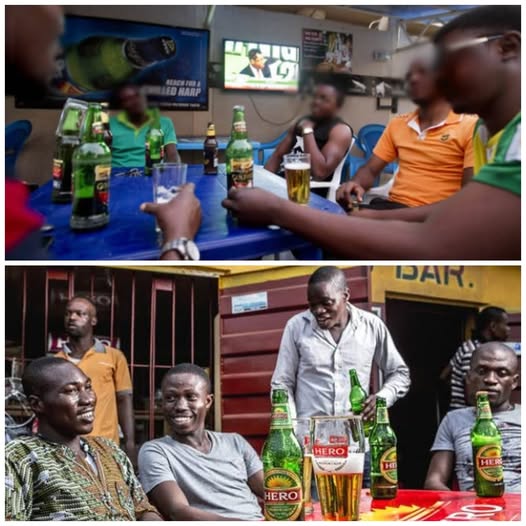
* Beer consumers
The Pathfinder
Thursday January 22, 2026
Please, share this story:
Nigerians spend heavily on beer
Nigerians spent an estimated ₦1.54 trillion on beer and non-alcoholic beverages within the first nine months of 2025, highlighting a striking economic contradiction as the country battles one of its worst cost-of-living crises in recent history.
An analysis of unaudited financial results released by Nigeria’s three major listed brewing companies—Nigerian Breweries Plc, International Breweries Plc, and Champion Breweries Plc—reveals a dramatic rise in industry revenue, even as household purchasing power continues to erode.
*Three-Year Revenue Surge
The data shows a steep upward trajectory in brewery revenues over the last three years, driven by persistent consumer demand and repeated price increases introduced by manufacturers grappling with rising production costs.
2023: Combined revenue ranged between ₦500 billion and ₦600 billion
2024: Revenue surged to approximately ₦1.1 trillion
2025: Industry earnings climbed to a record ₦1.54 trillion
Market leader Nigerian Breweries Plc alone surpassed the trillion-naira mark, posting ₦1.05 trillion in net revenue for the period ending September 30, 2025, compared to ₦710.87 billion recorded during the same period in 2024.
* An Economic Paradox
The figures have triggered intense debate among economists, who question how consumers facing widespread hunger and unemployment continue to sustain such high expenditure on alcoholic beverages.
Analysts attribute the phenomenon to the “Lipstick Effect,” a behavioural economic theory suggesting that individuals under financial strain gravitate toward affordable indulgences when larger aspirations—such as home ownership or vehicle purchases—become unattainable.
“For many Nigerians, drinking has become emotional relief,” said a Lagos-based economic researcher. “This ₦1.54 trillion is not just about alcohol consumption; it represents social coping. People are escaping a harsh economic reality through the only luxury still within reach.”
* Rising Costs, Shrinking Margins
Despite the impressive revenue growth, the brewing industry remains under severe financial pressure. Combined cost of sales stood at ₦631.23 billion, largely due to soaring energy prices, imported raw materials, logistics expenses, and currency volatility.
Brewers have responded by passing these costs directly to consumers through inflation-driven pricing, meaning Nigerians are paying significantly more for smaller quantities than they did in 2023.
While revenue performance appears strong at the surface level, profitability continues to suffer as Naira depreciation erodes margins.
Nigerian Breweries Plc: ₦1.05 trillion revenue; ₦415.15 billion gross profit
Total Industry Revenue: ₦1.54 trillion
Key cost drivers include the removal of fuel subsidies and the floating of the Naira, both of which have sharply increased production and distribution expenses.
* “No Money for Food, But Money for Beer”
The growing contradiction—often summarised as “no money for food, but money for beer”—has become emblematic of Nigeria’s 2025 economic reality.
Experts argue that as protein-rich foods become increasingly unaffordable, alcohol has emerged as a psychological escape, offering temporary relief from economic despair.
However, the cost of this relief continues to rise. A bottle of beer once considered a cheap indulgence in 2023 has become a significant expense by 2026, yet consumption volumes remain stubbornly high.
Northern Nigeria and the Hisbah Factor
Despite the nationwide surge in spending, alcohol consumption in Nigeria remains uneven due to strict religious enforcement in parts of the North.
In states such as Kano, Kaduna, and Zamfara, the Hisbah Corps continues to enforce a zero-tolerance policy on alcohol sales and consumption.
Over the past three years, an estimated five million bottles of beer, valued at several billions of naira, have reportedly been confiscated and publicly destroyed by Hisbah officials. These exercises, often carried out with bulldozers, represent not only massive losses for distributors but also significant foregone VAT revenue for the government.
“If the northern market were fully regulated instead of prohibited, industry revenue could easily exceed ₦2.5 trillion,” a retail market analyst observed. “Demand exists in the North, but it is either driven underground or suppressed by fear of enforcement.”
FTN
We are here to serve you news and information.
Your donations, reactions and advert placement are welcome.
Contact us on 08033783144 (WhatsApp)
08023469999(WhatsApp)
idowuadelusi@gmail.com,thepathfindernews0@gmail.com
Follow our reports also on X @idowuadelusi and Facebook (Idowu Oluwole Adelusi)