
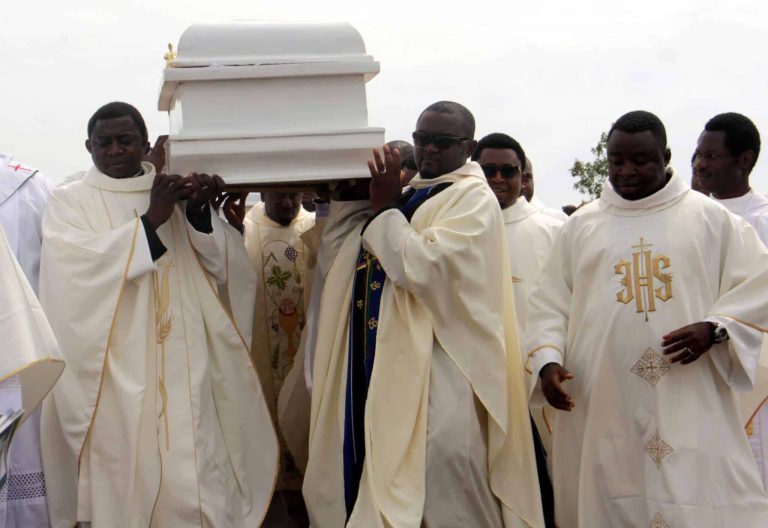
* Clergymen carry a white coffin containing the body of a priest allegedly killed by Fulani herdsmen, for burial at Ayati-Ikpayongo in Gwer East district of Benue State, north-central Nigeria on May 22, 2018. – Two Nigerian priests and 17 worshippers have been buried, nearly a month after an attack on their church, as Catholics took to the streets calling for an end to a spiral of violence. White coffins containing the bodies of the clergymen and the members of their congregation were laid to rest in central Benue state, which has been hit by a wave of deadly unrest. (Photo by EMMY IBU / AFP) (Photo credit should read EMMY IBU/AFP via Getty Images)
The Pathfinder
Monday April 13, 2026
Please, share this story:
International human rights organisations and religious watchdogs have raised fresh concerns over what they describe as persistent and targeted attacks on Christian communities in Nigeria.
In a recent assessment, several groups warned global humanitarian bodies that the country has become one of the most dangerous places for Christians, citing escalating violence particularly in the Middle Belt and North-East regions.
The report, released by the International Society for Civil Liberties and the Rule of Law, claimed that over 1,400 Christians were killed within the first quarter of 2026 alone, highlighting what it described as alarming mortality rates.
According to the group, Nigeria now accounts for a significant proportion of global deaths linked to religious persecution, with attacks frequently involving coordinated raids on rural communities in states such as Benue State, Plateau State, and Kaduna State.
Beyond the killings, the report also cited widespread abductions, destruction of churches, and mass displacement of residents. Advocacy groups argue that these incidents reflect a pattern of systematic violence, although the Nigerian government maintains that the crisis is driven by a complex mix of banditry, communal clashes, and competition over land and resources.
International Response Grows
The situation has begun to attract international attention, particularly from the United States, where authorities have reportedly introduced visa restrictions targeting Nigerian officials accused of failing to uphold religious freedom.
There are also ongoing discussions among U.S. lawmakers on whether Nigeria should be redesignated as a “Country of Particular Concern,” a classification that could carry diplomatic and economic implications.
Debate Over Nature of Violence
While some groups have described the attacks as ideologically driven and targeted at Christian populations, Nigerian authorities have rejected claims of genocide, insisting that insecurity in affected regions cuts across religious lines.
Security officials argue that the violence stems from broader challenges, including armed banditry and climate-related resource conflicts between farming and herding communities.
Humanitarian Concerns Deepen
Despite differing interpretations, the humanitarian impact remains severe.
Thousands of displaced persons continue to live in camps across affected regions, facing uncertain conditions and ongoing security threats.
Observers say the rising death toll and scale of displacement have intensified calls for intervention by the United Nations and other international bodies.
As concerns grow, stakeholders warn that failure to address the crisis decisively could further strain Nigeria’s social cohesion and deepen instability across vulnerable communities.
—————————————-
Share your story or advertise with us:
08033783144 (WhatsApp)
08023469999(WhatsApp)
idowuadelusi@gmail.com,thepathfindernews0@gmail.com
Follow our reports also on X @idowuadelusi and Facebook (Idowu Oluwole Adelusi)
Instagram: https//www.instagram.com/idowuoluwoleadelusi